Fundraiser ideas for nonprofit organizations
So you're deciding what sort of event to host? Let's talk through some fundraiser ideas for nonprofit organizations and see which one might be best for your purposes. First, let's review what the major choices include.
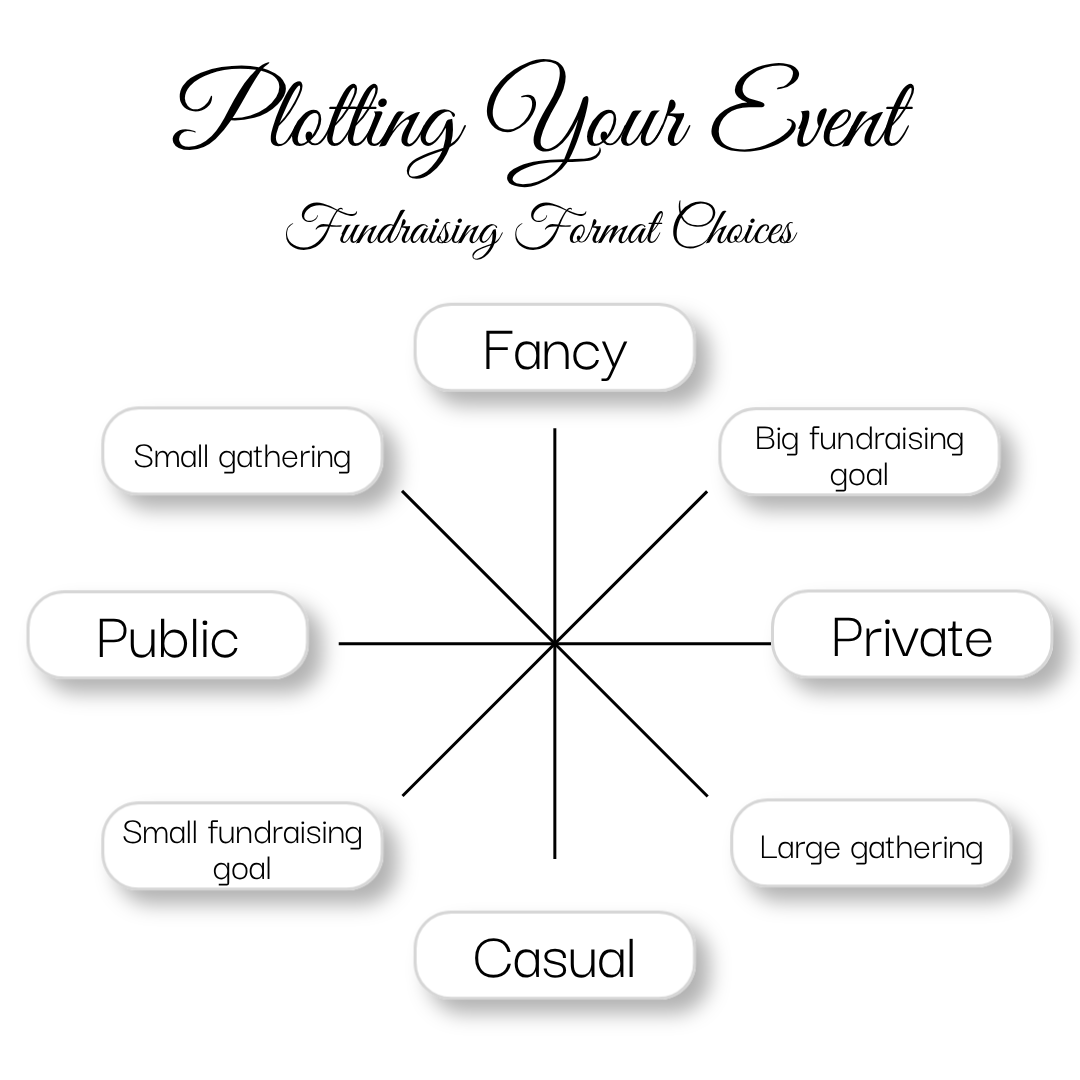
When choosing what type of event to host, you need to consider the big choices first. Each choice eliminates an alternative. For example, your event can either be fancy or casual, or somewhere in between, but it cannot be both. Just like it can either be small or large, or maybe medium, but it cannot be both small and large. This chart is a place to plot out an event's biggest qualities.
Here is an example of three different types of events and how they fit onto the chart:
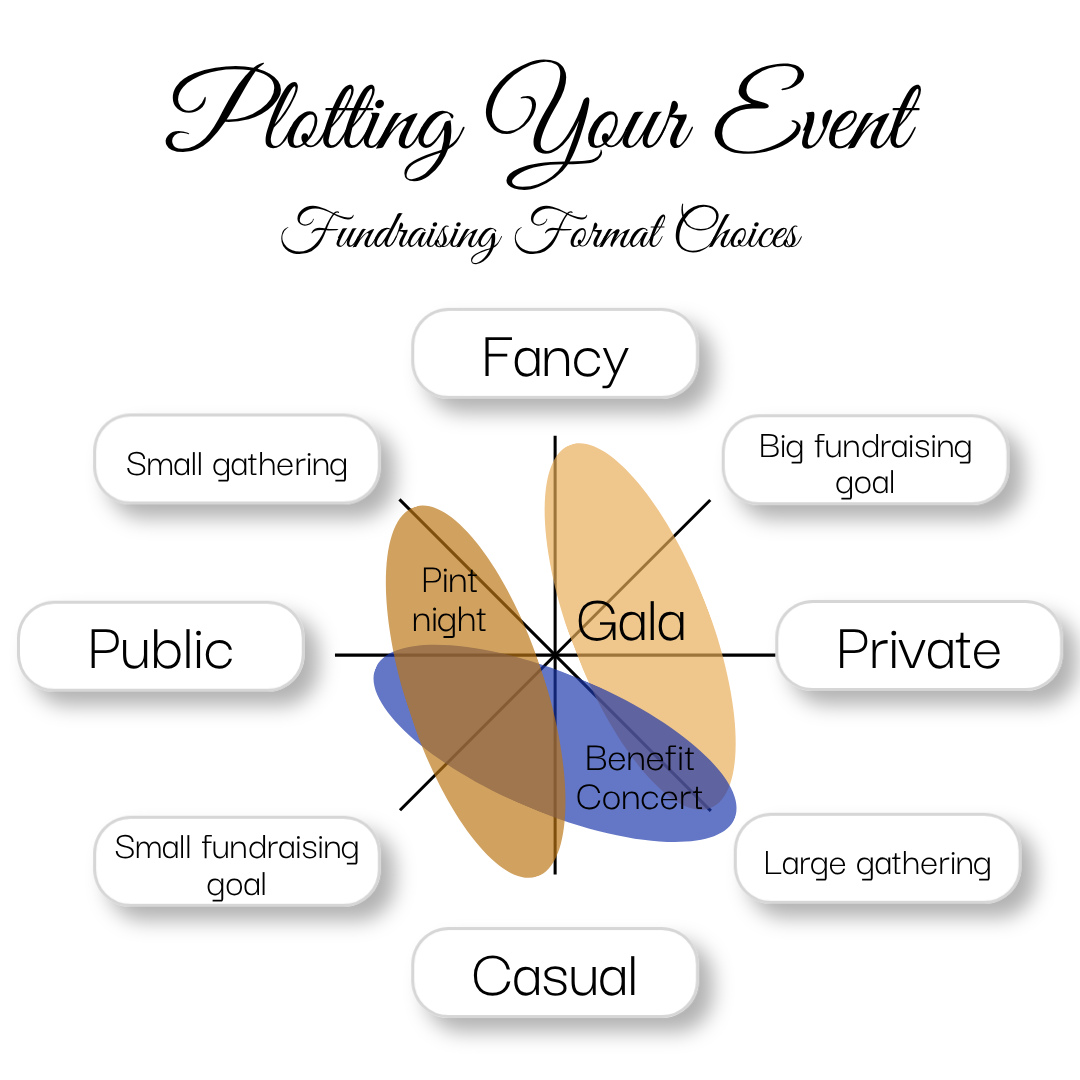
The gala is fancy, has a big fundraising goal, is private (meaning exclusive to certain guests, and will be a large gathering.
The pint night is the polar opposite - it will be casual, for the public, have a small crowd and small fundraising goal.
The benefit concert will be just in-between. It will be large, public, casual, and have a small fundraising goal.
These are the four large choices you must determine before you choose an event type. You already know your fundraising goal, so you've already got one part of the chart plotted! Now let's deal with the next two - the scale and exclusivity.
Review the decision tree below for general advice on how to proceed.
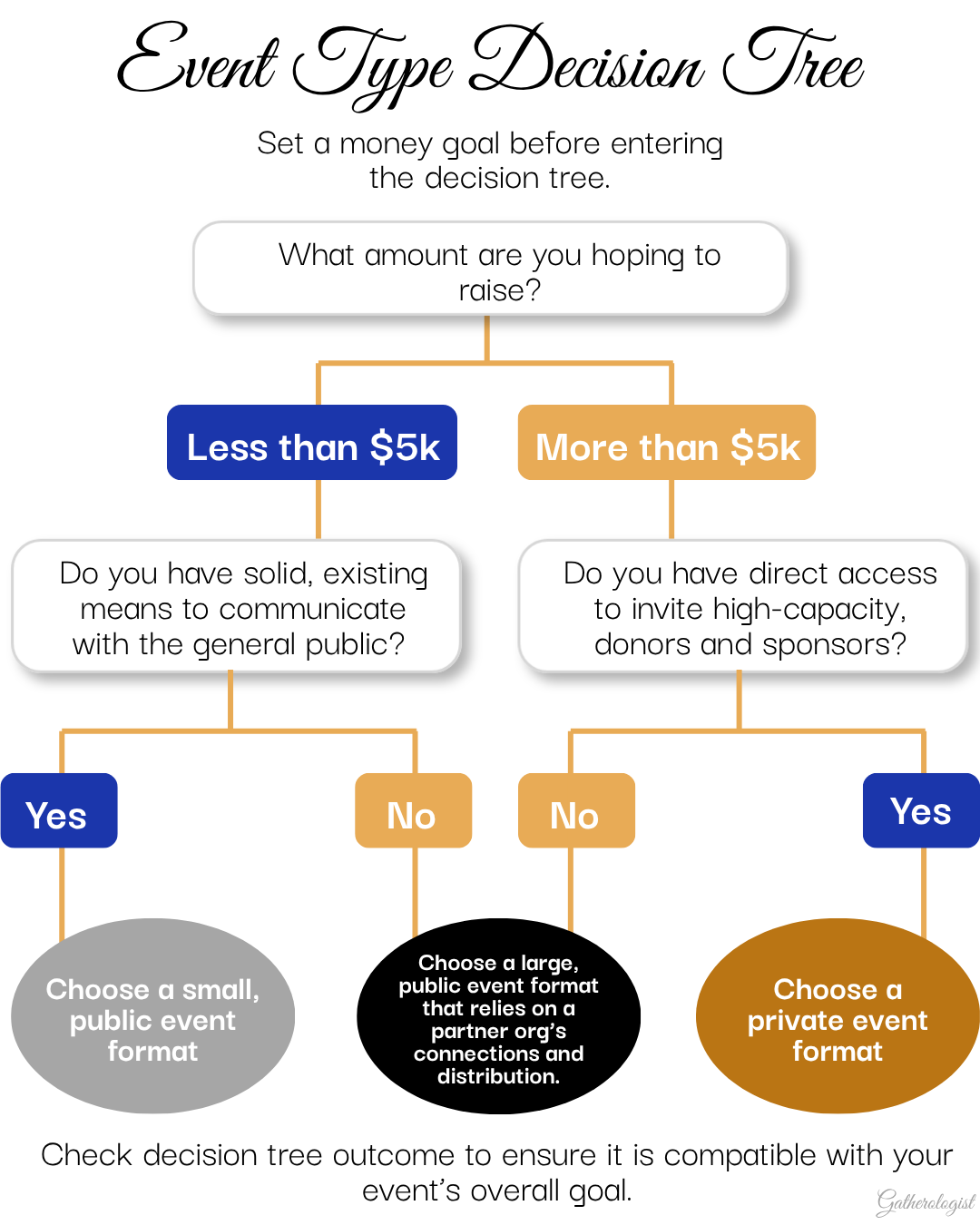
Where did you land?
Small, public event format.
Small, public event format.
Brilliant! You can achieve this event in a shorter time frame and it will require less planning than other event types.
Large, public event format.
Large, public event format.
Wow! This is going to be a big fundraiser and attract lots of new donors to your organization. It's going to take a lot of planning and partnering.
Private Event Format (size TBD)
Private Event Format (size TBD)
Awesome. Private events are intimate and take lots of careful planning, but ultimately are less work than large public events. Size is entirely dependent on how much money you intend to raise.
Now that you know what format of event, let's make sure it's compatible with your overall goal, and your time/energy. A couple quick scenarios to help us work when to stick to the plan or deviate for, well, sanity.
Scenarios: Fundraiser ideas for nonprofit organizations
Scenario #1 - The rush job
Your goal is to raise $40,000 at a brand new event before the end of the year. It's already September. Based on the decision tree, you landed on a large, public event. What should you do?
Answer: Skip straight to the private donor event and partner with an organization who is willing to be the "host" on your behalf and invite their wealthy contacts. November and December are tricky times to plan events since everyone will have holidays and families in town. Consider scheduling the event for early December, or for the week between Christmas and New Years.
Scenario #2 - The Low Donor Count
Your goal is to raise $70,000 at your annual gala, and the decision tree above affirmed a private donor event. However, many of your major donors have already given gifts or indicated they won't be attending the gala. Your guest list is considerably smaller than it needs to be to raise these kinds of funds. What should you do?
Answer: Keep the event as-is. Enlist "event ambassadors" from your major donors and invite them to attend without giving as long as they bring two friends who will give at a high capacity.
What to do when you are short on time
For most nonprofit employees, event planning is only a fraction of their actual job. Fundraisers can be very time-consuming to plan. If you can envision the fundraiser, but not how to pull it off, here are a few ideas:
- Scale back the event. No one wants to hear this, but some events are just too much work in not enough time. Planning them shoddily is worse than not planning them at all. Keep your scope within what you can handle, and trim the excess that does not add value.
- Enlist a volunteer. If you have board or committee members looking to get more involved, enlist their help!
- Work with a partner organization. Some places have events staff who are willing and able to help sort out certain details. If your event benefits another organization, delegate what you can to their team.
- Simplify. Simplify. Simplify. Is your event layered, complicated, or unnecessarily complex? Start trimming. No one needs a "save the date", just send the invitation. No one will miss the fifth and sixth types of appetizer if you cut them.
- Hire an event planner. It will cost several thousand dollars, and it's only appropriate to do this for larger scale events. A good event planner will essentially pay for themselves.
It's time to check out the fundraiser ideas for nonprofit organizations based on your decision tree results.
See ideas for small, public charity events.
See ideas for large, public charity events.
See ideas for private events (size TBD).