Should I have an event?
The most valuable, time-saving question you can ask yourself in event planning is this: Should I have an event? Nonprofit event planning can lead in so many different directions, but most forget to ask the important question "Why should we even start?" If you have an impenetrable answer to that question, great! If your answer is something like, "This is what we've always done," or "the person in charge asked for this," then your event will have problems before it even begins and throughout its lifespan.
Should I Have An Event?
Every gathering must have a goal. Sometimes the goal is tangible (i.e. raising money, getting volunteer sign-ups). Other times the goal is emotional (i.e. welcoming new team members, celebrating a big win). Whatever the goal is, the entire event must serve it. Down to the very last detail. But starting, of course, with the very first detail: "Should we even have an event?" The answer is "yes" if:
- The event brings together key people who must gather in order to achieve their specific aim. (i.e. a board retreat is an essential purpose for a meeting; as opposed to hosting a tea with volunteers... they'd probably rather be volunteering than having tea).
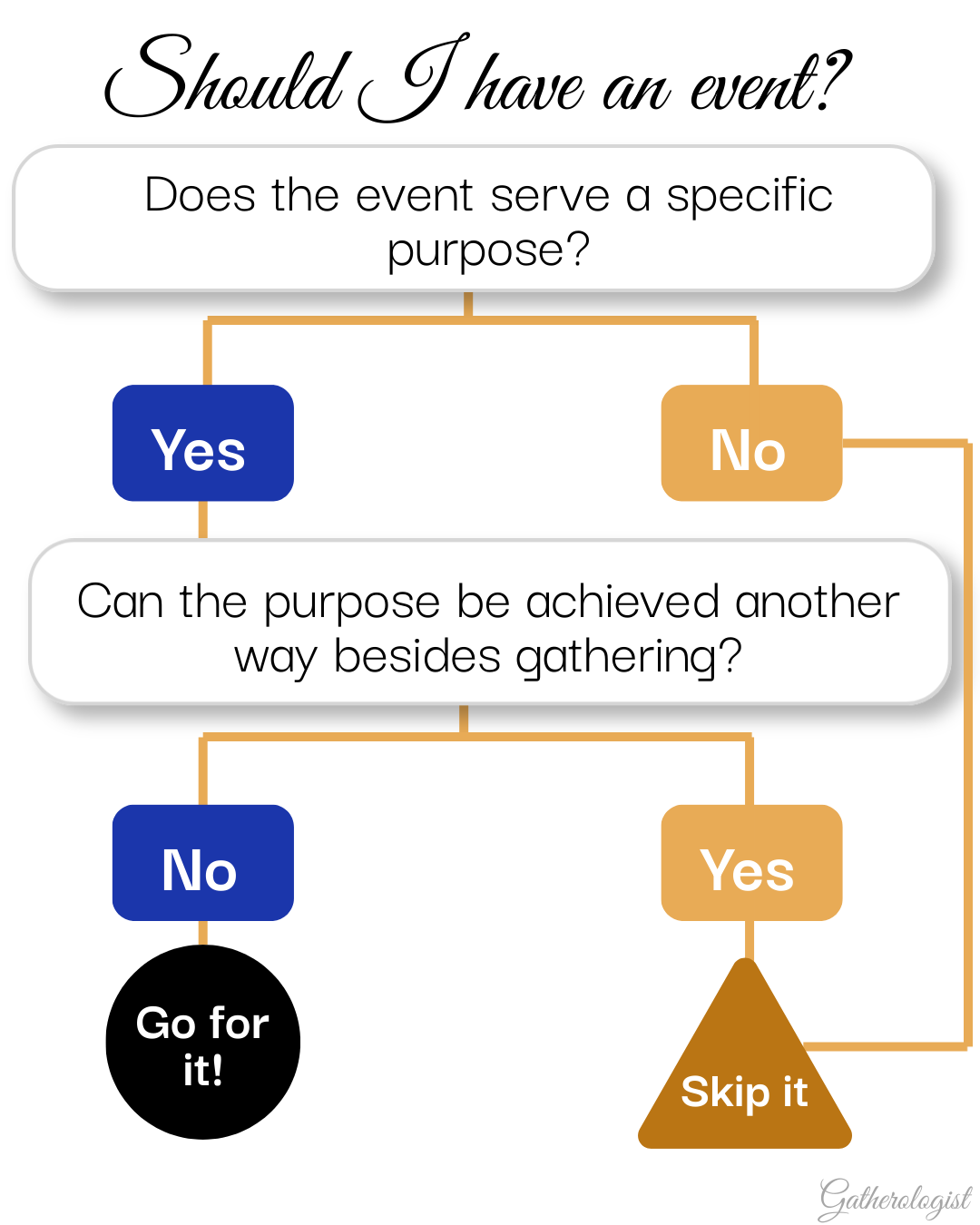
Get so clear on your gathering's aim. So clear you can see straight through it. Ask yourself "why" over and over like a toddler until the actual "why" reveals itself.
Example: you're hosting your annual holiday party for your virtual team.
Why?
Because we always have a holiday party. It would be weird if we didn't. (true, but not good enough.)
Why?
So they can get to know each other better. (getting warmer...)
Why?
Because they all work from home. (BINGO.)
This team who never gets to get together outside of work could use some camaraderie. Preferably a gathering that is either in-person or simulates in-person gathering. Mailing holiday celebration kits to your team so they have something tactile that makes them feel included and like their experience is shared.
The Event is a Go! Now what?
Assuming your event has a strong goal and passed the "why" test, congratulations, you are now on your way to planning a nonprofit event! So why does it feel like you've been given a burden rather than a gift? Let's get this part out of the way now. Event planning at NGOs is... kind of the worst. There's often little to no budget, training, or direction. You could get lucky and land a sweet gig with a platinum business card and years of carefully kept records on previous' years event plans. This is rather rare. In general, event planning is something that is expected of even folks whose jobs seem to have nothing to do with events. Because of this, a lot of people get put in the position of planning events without any discernible skills or experience.
Most people end up learning on the job. No one actually teaches you how to plan nonprofit events. And that is kind of terrifying. I mean, there are a million ways events can go wrong. You might be wondering how you even got assigned this task. There are a handful of usual reasons that you may have been given this very difficult, unclear, hard-to-break-down-into-bite-sized-pieces task:
- You're the only person on the team willing to do it
- You're the person on the team most capable of learning new skills
- You're the least busy person on the team (not that you are not busy, just the least busy)
- You're the only one the boss trusts to get it right
- My personal favorite: it's in your job description.
And all of these reasons are somewhat legitimate reasons to be assigned an event planning post. So, regardless of how you got here, welcome. You are in good hands. And my first piece of encouragement to you is this:
There are so many right ways to move forward.
It's not about finding the one right path. It's about making choices that all support the event goal, and recognizing there are lots of great options for doing so.
On that note - if there are so many good choices, then where do we start? With the goal, of course! Every decision from here forward must serve the goal. Here are some examples of event decisions that support goals:
- Goal: Show our donors we are fiscally responsible.
- Choice: choose a low-cost venue and serve simple fare.
- Wrong choice: Expensive venue with an open bar serving fancy cocktails.
- Goal: Regroup our team after a key member retires.
- Choice: Team-building lunch that allows current members' skillsets to shine.
- Wrong choice: Invite retired member to join us for lunch.
- Goal: Help our partners understand what we do.
- Choice: host a networking breakfast where we have the only booth.
- Wrong choice: Let all our partners set up booths (would be a great choice if the goal were to let all our partners get to know each other better.)
Your next move is to choose the type of event with which to move forward. Does the goal involve your internal staff, your donors, or the community at large?
My event involves donors
My event involves donors
Visit donor events page
My event involves internal staff, volunteers, board members and committee members.
My event involves internal staff, volunteers, board members and committee members.
Visit Internal Events Page
My event involves the community at large.
My event involves the community at large.
Visit Community Events Page